What Are Impacted Teeth & Why Do They Happen?
Have you ever felt pain at the back of your mouth that just wouldn’t go away? Or noticed swelling near your wisdom tooth area? In many cases, the reason could be impacted teeth, a common yet often misunderstood dental problem.
At Surad Dental Clinic, we frequently treat patients who are unaware that their discomfort, jaw stiffness, or recurring gum infection is caused by a tooth that hasn’t erupted properly.
Let’s understand what impacted teeth are, why they happen, and when you should seek treatment.
What Are Impacted Teeth?
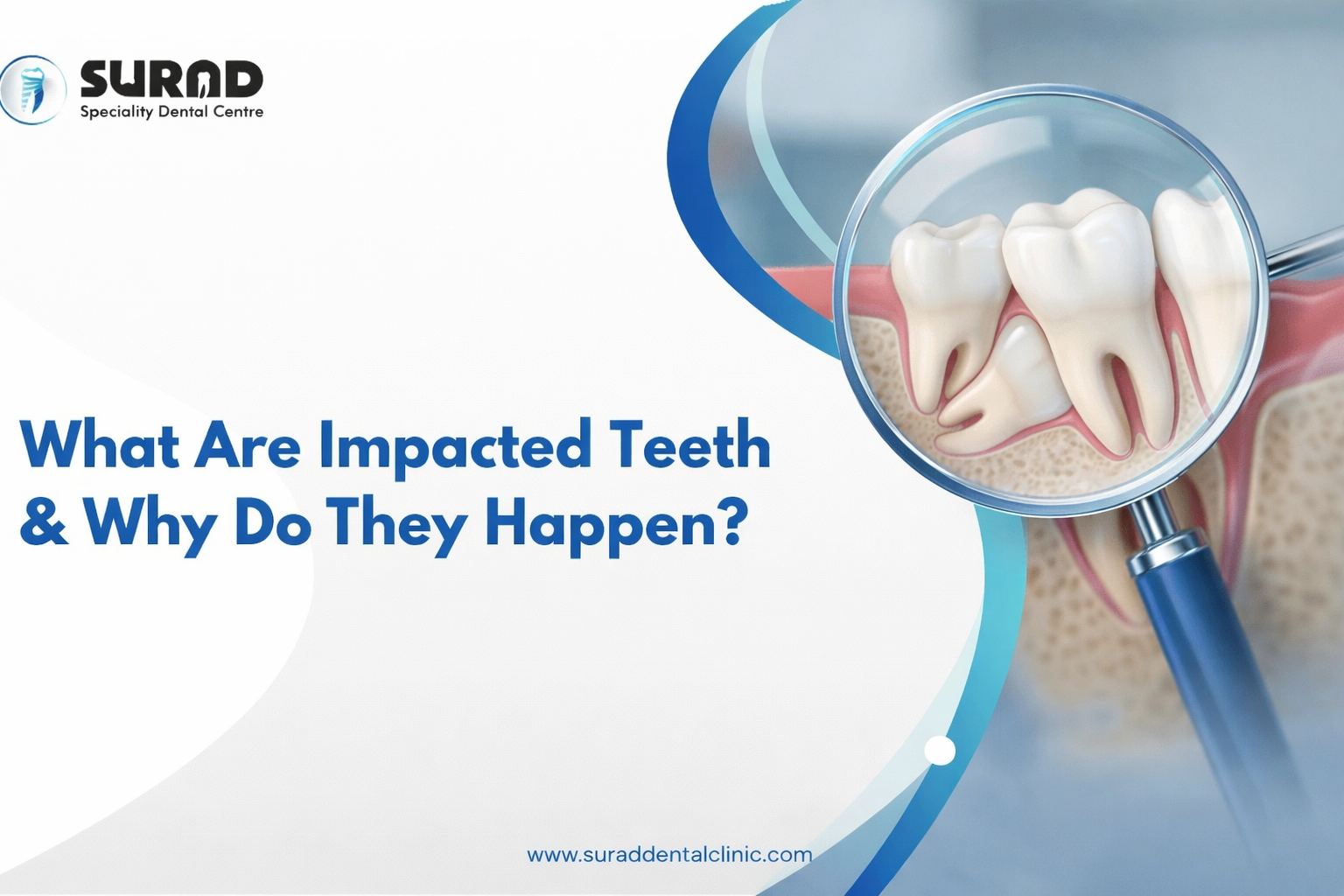
An impacted tooth is a tooth that fails to fully emerge into its proper position in the mouth. Instead of growing straight through the gum, it gets stuck — either partially or completely, beneath the gum or bone.
The most commonly impacted teeth are:
Wisdom teeth (third molars)
Upper canine teeth
Occasionally premolars
Among these, wisdom teeth are the most frequently affected because they erupt last, usually between the ages of 17 and 25, when there may not be enough space left in the jaw.
Types of Impacted Teeth
Impaction is not the same in every case. It can vary depending on how the tooth is positioned.
1. Soft Tissue Impaction
The tooth has partially erupted but is still covered by gum tissue.
2. Partial Bony Impaction
The tooth is partially trapped within the jawbone.
3. Full Bony Impaction
The tooth is completely stuck inside the jawbone and hasn’t emerged at all.
4. Angular Impaction
The tooth grows at an angle, sometimes pushing against the adjacent tooth.
Each type requires different treatment planning, which is why proper dental evaluation and X-rays are essential.
Why Do Impacted Teeth Happen?
There isn’t just one reason. Several factors contribute to tooth impaction.
1. Lack of Space in the Jaw
Modern diets and evolutionary changes have led to slightly smaller jaws in many people. When there isn’t enough space, the last teeth (wisdom teeth) get stuck.
2. Wrong Eruption Angle
Sometimes the tooth develops at an improper angle and cannot align correctly.
3. Overcrowding
If teeth are crowded, there may be no room left for new teeth to erupt.
4. Genetics
If your parents had impacted teeth, you may have a higher chance of experiencing it.
5. Delayed Tooth Eruption
Certain teeth, especially upper canines, may fail to erupt at the expected time due to developmental reasons.
Common Symptoms of Impacted Teeth
Some impacted teeth cause no symptoms at all. Others can create significant discomfort.
Here are the warning signs:
Pain at the back of the mouth
Swelling of gums
Red or bleeding gums
Jaw pain or stiffness
Difficulty opening the mouth
Bad breath
Unpleasant taste
Headache
Pressure on neighboring teeth
If you experience these symptoms repeatedly, it’s important to get examined.
What Problems Can Impacted Teeth Cause?
Ignoring impacted teeth can lead to serious complications.
1. Infection (Pericoronitis)
One common issue is Pericoronitis , an infection of the gum tissue surrounding a partially erupted tooth. Food particles and bacteria get trapped under the gum flap, causing swelling and pain.
2. Damage to Nearby Teeth
An impacted tooth pushing against another tooth can cause decay or bone loss.
3. Cysts
Fluid-filled sacs may develop around impacted teeth, damaging bone and nearby teeth.
4. Tooth Decay
Impacted wisdom teeth are difficult to clean, increasing the risk of cavities.
5. Gum Disease
Bacteria accumulation around partially erupted teeth can lead to periodontal problems.
Early diagnosis prevents these complications.
How Are Impacted Teeth Diagnosed?
At Surad Dental Clinic, diagnosis includes:
Clinical oral examination
Digital X-rays
OPG (panoramic imaging)
These tools help determine:
Tooth position
Depth of impaction
Relationship with nerves
Need for removal
Imaging ensures safe and precise treatment planning.
Do All Impacted Teeth Need Removal?
Not always.
Some impacted teeth:
Cause no pain
Do not damage nearby teeth
Are fully covered and infection-free
In such cases, monitoring may be advised.
However, removal is recommended if:
Pain is recurring
Infection develops
The tooth is damaging adjacent teeth
Orthodontic treatment requires space
Early removal is often simpler and heals faster compared to waiting until complications arise.
What Is Impacted Tooth Removal Like?
Many patients fear the word “surgery,” but modern dentistry makes the process safe and comfortable.
The procedure usually involves:
Local anesthesia to numb the area
Small incision in the gum
Removal of bone if needed
Gentle extraction of the tooth
Stitches (if required)
The procedure duration depends on complexity but usually takes 20–45 minutes.
Recovery After Impacted Tooth Removal
Healing is generally smooth when proper instructions are followed.
Aftercare Tips:
Avoid rinsing for 24 hours
Use prescribed medications
Apply ice packs for swelling
Eat soft foods
Avoid smoking
Maintain gentle oral hygiene
Most swelling reduces within 2–3 days. Complete healing takes about 1–2 weeks.
At Surad Dental Clinic, we ensure patients receive detailed post-operative guidance for quick recovery.
Impacted Canines: A Special Case
Not only wisdom teeth can be impacted. Upper canine teeth may fail to erupt, especially in teenagers.